Agile Unleashed at Scale: Results at a Glance

Approfondissez votre maîtrise de Scrum, renforcez votre posture de Scrum Master et préparez-vous à la certification PSM II
In 2019 John Deere’s Global IT group launched an Agile transformation with the simple but ambitious goal of improving speed to outcomes.
As with most Fortune 100 companies, Agile methodologies and practices were not new to John Deere’s Global IT group, but senior leadership wasn’t seeing the results they desired. “We had used other scaled frameworks in the past—which are perfectly strong Agile processes,” explains Josh Edgin, Transformation Lead at John Deere, “But with PSI planning and two-month release cycles, I think you can get comfortable transforming into a mini-waterfall.” Edgin adds, “We needed to evolve.”
Senior leadership decided to launch a holistic transformation that would touch every aspect of the group’s work – from application development to core infrastructure; from customer and dealer-facing products to operations-oriented design, manufacturing and supply chain, and internal/back-end finance and human resource products.
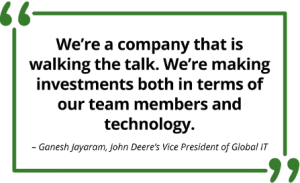
Picking the right Agile framework is one of the most important decisions an organization can make. This is especially true when effective scaling is a core component of the overall strategy. “Leadership found the Scrum@Scale methodology to be the right fit to scale across IT and the rest of the business,” states Ganesh Jayaram, John Deere’s Vice President of Global IT. Therefore, the Scrum and Scrum@Scale frameworks, entwined with DevOps and technical upskilling became the core components of the group’s new Agile Operating Model (AOM).
Picking the right Agile consulting, training, and coaching support can be just as important as the choice of framework. Scrum Inc. is known for its expertise, deep experience, and long track record of success in both training and large and complex transformations. Additionally, Scrum Inc. offered industry-leading on-demand courses to accelerate the implementation, and a proven path to create self-sustaining Agile organizations able to successfully run their own Agile journey.
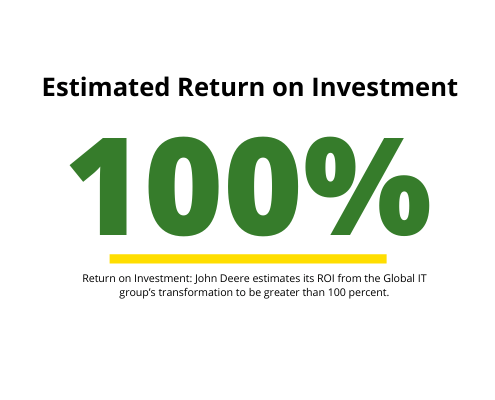
“I remember standing in front of our CEO and the Board of Directors to make this pitch,” says Jayaram, “because it was the single largest investment Global IT has made in terms of capital and expense.” But the payoff, he adds, would be significant. “We bet the farm so to speak. We promised we would do more, do it faster, and do it cheaper.”
John Deere’s CEO gave the transformation a green light.
Just two years into the effort it is a bet that has paid off.
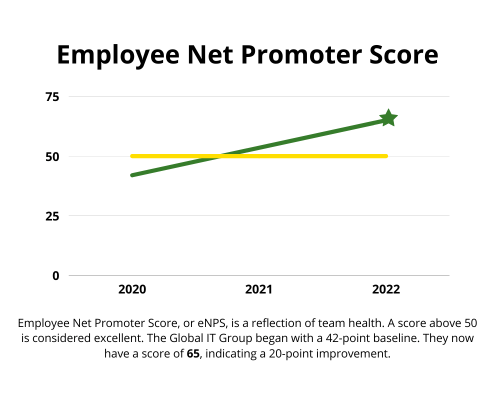
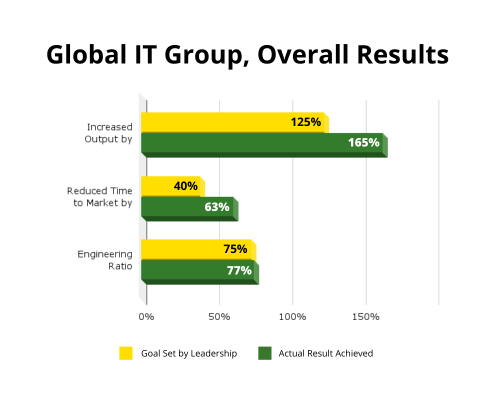
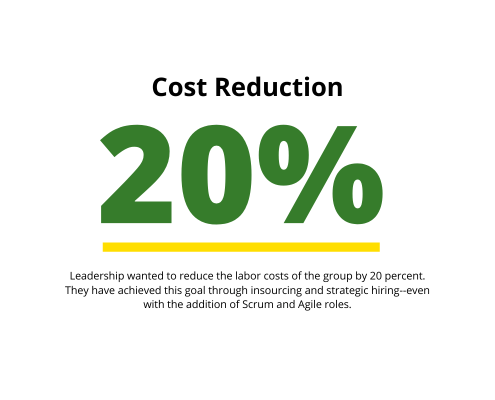
Enterprise-level results include:
John Deere’s Global IT group has seen function/team level improvements that far exceed these results. Order Management, the pilot project for this implementation has seen team results which include:
As Jayaram notes, “When you look at some of the metrics and you see a 1,000 percent improvement you can’t help but think they got the baseline wrong.”
But the baselines are right. The improvement is real.
John Deere’s Global IT group has also seen exponential results thanks to the implementation of the AOM. “We’ve delivered an order of magnitude more value and bottom-line impact to John Deere in the ERP space than in any previous year,” states Edgin. These results include:
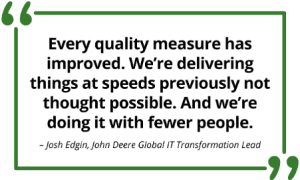
Edgin adds that “every quality measure has improved measurably. We’re delivering things at speeds previously not thought possible. And we’re doing it with fewer people.”
In addition to embedded coaches working with teams across the organization, John Deere implemented a wave/phase approach to training at scale. This ensures effective training and minimal interruption to daily operations. The first week of the immersion phase is the only time teams aren’t dedicated to their usual duties.
The Wave/Phase approach has ensured both effective and efficient training across John Deere’s Global IT group. As of December 2021, roughly 24-months after its inception:
John Deere’s Global IT group is well on its way to becoming a self-sustaining Agile organization thanks to its work with Scrum Inc.
Source ScrumInc.